Cpio Review / BEA / Trade deficit
Trade Deficit Widens to $105.6B, a Quiet Test for GDP Growth
August's U.S. trade deficit jumped to $105.6 billion as imports outpaced exports. What the wider gap could mean for GDP growth and what to watch next.
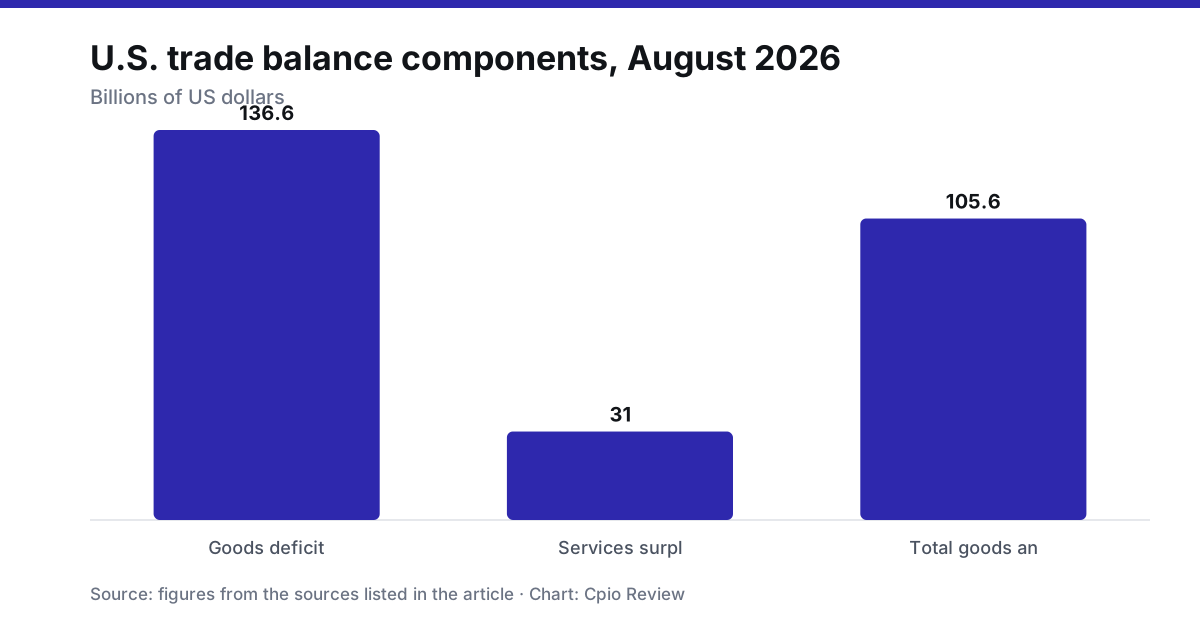
The U.S. trade gap opened up in August. According to the Bureau of Economic Analysis and the Census Bureau, the goods and services deficit rose to $105.6 billion from a revised $92.8 billion in July. Trade data rarely draws the attention that jobs or inflation reports do, but it feeds directly into the arithmetic of GDP growth, so a move of this size deserves a careful look.
Key takeaways
- The combined goods and services deficit rose by $12.8 billion in August, to $105.6 billion, from a revised $92.8 billion in July.
- The agencies attribute the widening to imports increasing by more than exports.
- Nearly all of the change came from goods: the goods deficit grew by $12.8 billion to $136.6 billion.
- The services surplus barely moved, edging up by less than $0.1 billion to $31.0 billion.
- Watch the revisions and the next release to see whether August was a one-month jump or the start of a wider gap.
What the August report actually says
The release is brief on the headline numbers. The total deficit increased from $92.8 billion in July, a figure that has itself been revised, to $105.6 billion in August. That is an increase of $12.8 billion, or roughly 14 percent of the July level. The agencies say imports rose more than exports, which is the simple mechanical reason the gap widened.
The composition matters more than the total. The goods deficit rose by $12.8 billion to $136.6 billion, so the goods side accounts for essentially the whole change. The services surplus rose by less than $0.1 billion to $31.0 billion. The headline deficit is the goods shortfall minus the services cushion, and the figures reconcile: $136.6 billion less $31.0 billion gives $105.6 billion. Working backward, the goods deficit in July was about $123.8 billion.
This pattern is a familiar one in the U.S. external accounts. Services trade offsets part of the gap in goods, but it is too stable to absorb swings in physical merchandise flows. When the trade balance moves sharply from one month to the next, the cause is almost always in goods. The summary does not break out which categories of goods drove the increase or which trading partners were involved, so any more specific explanation would be speculation at this stage.
Why it matters for GDP growth
Trade figures matter because of how output is measured. In the national accounts, GDP growth counts spending on domestically produced goods and services. Imports are subtracted so that spending on foreign-made products is not credited to the U.S. economy. Net exports, meaning exports minus imports, are therefore a component of the calculation. Other things equal, a wider deficit subtracts from measured growth, and a narrower one adds to it.
“Other things equal” is an important caveat. Imports are not a leak that signals weakness in themselves. Households buying more imported goods, or businesses bringing in equipment and inputs, can reflect solid domestic demand. A larger deficit can therefore coincide with a healthy economy, and the GDP arithmetic only records that the foreign-made portion is not domestic production. The same increase in imports can also be matched elsewhere in GDP, for example in consumer spending or inventories, which leaves the overall growth effect smaller than the headline gap suggests.
The release provided here is a monthly trade report, not a GDP estimate, and it contains no growth figures. Without the underlying inflation-adjusted trade data and the other GDP inputs, one cannot say how much August’s widening will weigh on the quarter. What can be said is the direction of the pressure: if the wider gap persists through the rest of the period, trade is likely to be a less favorable contributor than it would be with a stable or narrowing deficit.
Who is affected and what to watch
The most direct readers of this release are forecasters who build quarterly growth estimates, since each trade report updates the net-exports piece of the puzzle. Importers, exporters and logistics firms also watch the monthly flows as a sign of how much goods are moving across the border. For households, the effect is indirect and shows up through the prices and availability of imported goods, though this report does not address either.
There are several things to watch in coming releases. The first is revision. July’s deficit has already been revised to $92.8 billion, and the August figure may be adjusted again, so the size of the jump could change. The second is persistence. A single month in which imports outpace exports can reverse quickly, particularly in goods, where shipment timing can move large amounts from one month to the next. A second consecutive widening would be a firmer signal than one reading. The third is the goods-versus-services split. If the services surplus stays near $31.0 billion, the direction of the headline balance will continue to depend almost entirely on merchandise trade.
Finally, the trade data should be read alongside the broader set of indicators. Inflation measures such as CPI inflation and PCE inflation, the monthly nonfarm payrolls report and the unemployment rate each describe a different part of the economy. The trade balance connects to all of them because it reflects how much of domestic demand is met from abroad. No single monthly reading settles the question, but a $12.8 billion step in the deficit is large enough that analysts will be asking what is behind it.
A measured reading
The August report shows a trade deficit that is meaningfully wider than the month before, driven by goods, with services little changed. It does not by itself show an economy that is weakening or strengthening, and it should not be treated as a verdict on GDP growth. It is a data point that will shape how economists adjust their near-term growth estimates and a reminder that the external sector can move the headline numbers even when domestic conditions are steady.
The next trade release, along with revisions to the figures above, will show whether August marks a new level for the deficit or a temporary spike. Until then, the most defensible conclusion is the narrow one: imports grew faster than exports, goods carried the change, and the effect on growth depends on what happens to the rest of the economy.
Prepared with AI assistance from the releases listed under Data sources and reviewed under our editorial policy. Not investment advice.