Cpio Review / BEA / GDP
GDP growth hits 3.4% in Q3, but spending outpaces income
The BEA's advance estimate shows GDP growth of 3.4% in Q3 2026, up from 2.2%, while September spending jumped 0.5% and the saving rate slipped to 3.8%.
The U.S. economy ended the third quarter on a stronger footing than it began it. According to the advance estimate from the Bureau of Economic Analysis (BEA), real gross domestic product rose at an annual rate of 3.4 percent in July, August and September, up from 2.2 percent in the second quarter. A companion release published the same morning showed that households were spending faster than they were earning by the end of the period. Taken together, the two reports describe an expansion that is running at a healthy clip, with questions about what is paying for it.
Key takeaways
- Real GDP grew at a 3.4 percent annual rate in the third quarter of 2026, compared with 2.2 percent in the second quarter, per the BEA’s advance estimate.
- Investment, consumer spending and government spending added to growth; a decline in exports partly offset them, and higher imports subtracted.
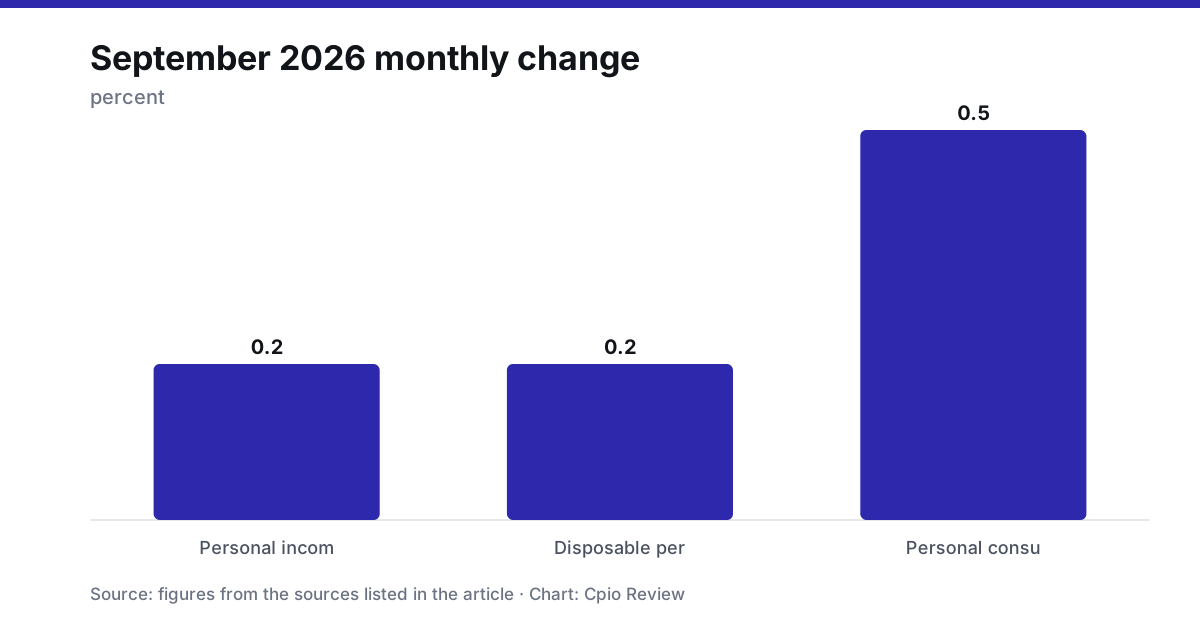
- In September, personal income rose 0.2 percent while personal consumption expenditures rose 0.5 percent.
- The personal saving rate was 3.8 percent of disposable income, with saving at $911.1 billion.
What the GDP growth figure says
A 3.4 percent annualized pace is a notable step up from the 2.2 percent recorded in the second quarter. The BEA attributes the acceleration to increases in investment, consumer spending and government spending. Those gains were partly offset by a decrease in exports, while imports, which are subtracted in the GDP arithmetic, increased.
The mix matters as much as the headline. Growth driven by domestic demand across three categories, business and residential investment among them, is generally seen as broader than growth that leans on a single source. At the same time, the combination of falling exports and rising imports means trade was a drag rather than a help. In practice, a portion of the domestic spending strength was met by foreign production rather than American output. That does not diminish the headline, but it does temper the interpretation that every dollar of new demand translated into domestic activity.
Readers should also remember what an advance estimate is. It is the first look at the quarter, assembled from incomplete data, and it is routinely revised as more complete information arrives. The 3.4 percent figure is a solid starting point for assessing momentum, not a final verdict. The second-quarter number it is compared against has already gone through that process; the third-quarter figure has not.
A consumer who is spending more than they earn
The personal income and outlays report for September fills in part of the household picture. Personal income increased $54.5 billion, or 0.2 percent, for the month. Disposable personal income, which subtracts personal current taxes, rose $52.7 billion, also 0.2 percent. Personal consumption expenditures, however, climbed $113.1 billion, or 0.5 percent.
The gap is the story. Spending grew by more than twice the dollar amount of the increase in disposable income. Personal outlays, which add interest payments and transfer payments to consumption, rose $113.0 billion. When outlays rise much faster than after-tax income, something else has to give, and the usual candidate is saving.
That is visible in the final line of the release. Personal saving stood at $911.1 billion, and the personal saving rate, saving as a share of disposable income, was 3.8 percent. A rate in that range means households are setting aside a relatively small slice of their after-tax income. It is not a crisis figure on its own, but it leaves less of a cushion should income growth slow or should an unexpected expense arrive.
Reading the two reports together
Consumer spending is the largest component of GDP, so a strong September for outlays is consistent with the BEA’s finding that household spending contributed to third-quarter growth. The risk in that relationship is one of sustainability. Spending that outruns income can continue for a while, funded by lower saving or by borrowing, but it cannot widen the gap indefinitely. If income growth of 0.2 percent a month remains the norm, consumption growth of 0.5 percent a month would be hard to repeat month after month without pushing the saving rate lower still.
There are reasons not to over-read a single month. Monthly spending data are volatile, and one strong reading does not establish a trend. It is also possible that part of the September increase reflects timing or one-off purchases rather than a durable change in behavior. The reports released today do not settle that question, and anyone claiming they do is reaching beyond the data.
What the numbers do support is a cautious, balanced reading. The economy gathered speed in the third quarter, and the pickup was supported by several parts of domestic demand. But the household sector, which supplies most of that demand, is drawing on its saving at a time when its income growth is modest.
What to watch next
Several things will shape how this story develops. The first is revisions: the BEA will update its third-quarter GDP estimate as more complete data come in, and the size and direction of those changes will show whether 3.4 percent was a fair first read. The second is the trade balance. If exports continue to fall while imports rise, net trade could keep subtracting from growth even if domestic demand holds up.
The third is the household saving rate. If it drifts lower in the coming months while spending keeps outpacing income, that would suggest consumption is leaning on a shrinking buffer. If it stabilizes or rebounds as income growth catches up, the case for durable expansion looks stronger. Finally, the next monthly income and outlays report will show whether September’s 0.5 percent jump in spending was a one-month surge or the start of a pattern.
For now, the data point in two directions at once: output is growing at a brisk pace, and the households behind much of that growth are stretching their budgets to sustain it. Which of those two facts matters more in the quarters ahead will depend on whether incomes begin to keep up.
Prepared with AI assistance from the releases listed under Data sources and reviewed under our editorial policy. Not investment advice.