Cpio Review / BEA / GDP
GDP Growth Revised Up to 2.2% in Q2 as Annual Update Lifts Estimates
BEA's third estimate lifts second-quarter GDP growth to 2.2% from 1.5%, raises the first quarter to 2.5% and trims the PCE price index to 5.0% in an update.
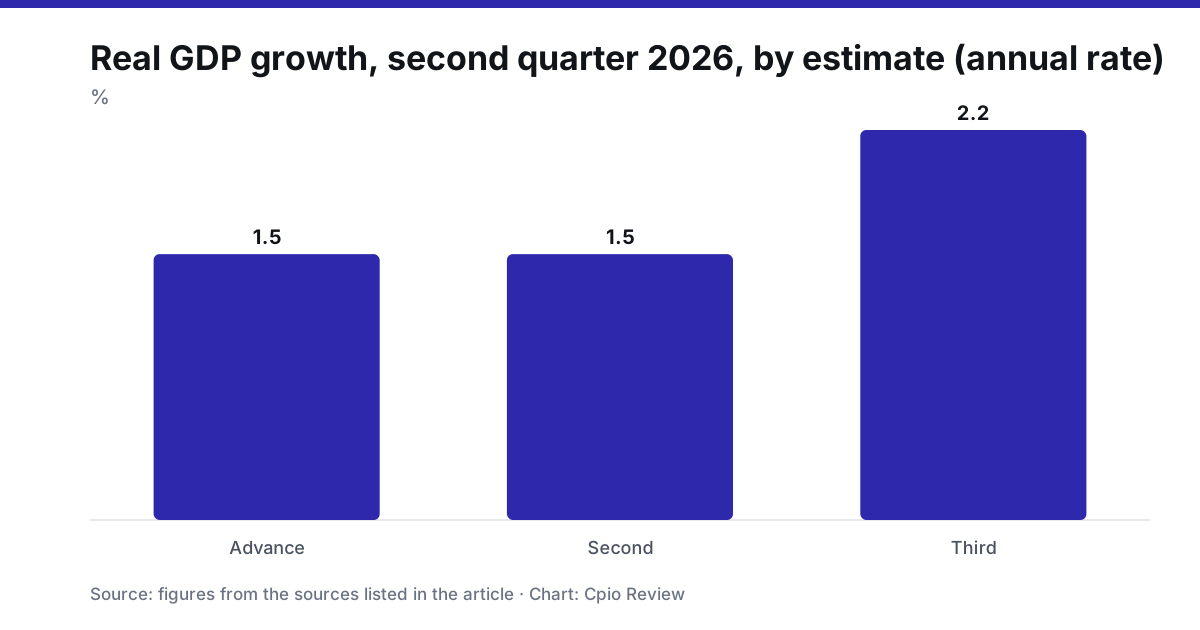
The economy grew faster in the spring than first reported, and not by a small margin. The Bureau of Economic Analysis said on Wednesday that real gross domestic product increased at an annual rate of 2.2 percent in the second quarter of 2026, according to its third estimate. The advance and second estimates had both put GDP growth at 1.5 percent. The first quarter was also revised higher, to 2.5 percent.
A 0.7 percentage point revision between the second and third estimates is large for a data release that normally moves in tenths. It reflects the fact that this edition coincides with the BEA’s 2026 annual update, which revised GDP, gross domestic income, GDP by industry and their major components back to the first quarter of 2021. The revisions raise the growth estimates, lower the inflation estimates and show a stronger first half than earlier data indicated.
What the third estimate changed
According to the BEA, the upward revision to second-quarter GDP growth primarily reflects higher estimates of investment, consumer spending and government spending. The contributors to growth were consumer spending, investment and exports; imports, which subtract from GDP, increased. Current-dollar GDP growth rose to 8.5 percent from 8.0 percent in the second estimate and 7.9 percent in the advance estimate.
The progression of the headline figure is straightforward. Real GDP growth was 1.5 percent in the advance estimate, 1.5 percent in the second estimate and 2.2 percent in the third. Real final sales to private domestic purchasers, the sum of consumer spending and gross private fixed investment, which many analysts use as a cleaner read on private demand, increased 4.6 percent, revised up 0.4 point. The path was 3.9 percent in the advance estimate and 4.2 percent in the second.
The gap between the two measures is wide. Private demand grew at 4.6 percent while GDP grew at 2.2 percent, a difference of 2.4 points. Imports, which are subtracted in the GDP calculation, account for part of it, along with components that sit outside private final sales, such as inventories and government.
Gross domestic income tells a similar story
Real gross domestic income, the income-side counterpart of GDP, increased 2.6 percent in the second quarter, revised up 0.4 point from the second estimate of 2.2 percent. The average of real GDP and real GDI rose 2.4 percent, an upward revision of 0.6 point from 1.8 percent. In theory GDP and GDI measure the same thing, and the average is often treated as the better guide when the two differ. By that measure the economy expanded at 2.4 percent, a notch above the 2.2 percent headline.
Corporate profits from current production, with inventory valuation and capital consumption adjustments, increased $384.0 billion in the second quarter, revised down $16.9 billion. That is a large quarterly gain, even with the trim.
Inflation estimates come down
The price estimates were revised in the opposite direction. The price index for gross domestic purchases increased 5.6 percent in the second quarter, revised down 0.2 point. The PCE price index rose 5.0 percent, revised down 0.3 point from 5.3 percent, and the PCE price index excluding food and energy rose 3.3 percent, also revised down 0.3 point from 3.6 percent. The advance estimates had been 5.1 percent and 3.4 percent for the two PCE measures.
The lower core PCE figure of 3.3 percent annualized matters for anyone assessing how persistent inflation is, since it puts underlying second-quarter inflation in the low 3 percent range.
The first quarter revisions go the same way. The PCE price index for that quarter is now estimated at 4.2 percent, down 0.4 point, and the core measure at 3.9 percent, down 0.5 point. Growth was revised up and inflation down, a combination that reads as a somewhat better first half than the earlier data indicated.
Industries and the first quarter
By industry, real value added increased 2.5 percent in private services-producing industries and 2.3 percent in private goods-producing industries, with government less than 0.1 percent. The leading contributors were real estate and rental and leasing, information, durable goods manufacturing, and finance and insurance. Transportation and warehousing, retail trade and nondurable goods manufacturing were the leading offsets. Real gross output rose 5.0 percent, with private services up 6.0 percent, goods up 3.0 percent and government up 2.6 percent.
The annual update changed the first quarter more than the usual third estimate would. GDP growth is now 2.5 percent, up 0.4 point, reflecting higher exports of services and consumer spending on goods and services. Real GDI is now 2.5 percent, 1.3 points higher than before, driven mainly by compensation, based on new first-quarter wage and salary data from the BLS Quarterly Census of Employment and Wages. The industry view of the first quarter shifted as well: goods-producing industries revised down by 3.0 points to 1.5 percent, services up 1.3 points to 2.1 percent, and government down 1.2 points to 6.3 percent. First-quarter corporate profits rose $63.4 billion, revised down $11.0 billion.
States and households
The release also covers regional data. Real GDP increased in 44 states and the District of Columbia in the second quarter, at annual rates ranging from 4.0 percent in New York to minus 2.3 percent in West Virginia. Finance and insurance led the increase in New York and Delaware, while mining was the largest drag in West Virginia and Wyoming.
Personal income rose $314.3 billion, or 4.7 percent at an annual rate, and increased in 49 states and the District of Columbia, from 6.4 percent in Wisconsin to minus 4.2 percent in North Dakota. Property income rose in every state, from 5.1 percent in Tennessee to 3.3 percent in Iowa. For 2025, current-dollar personal consumption expenditures rose 5.3 percent nationally, with Florida the highest at 7.0 percent and California the lowest at 4.2 percent among the states.
What to watch
The revisions change the baseline. With growth of 2.5 percent in the first quarter and 2.2 percent in the second, the economy entered the second half on firmer footing than the 1.5 percent estimate suggested. Anyone comparing earlier forecasts or commentary with the new numbers should note that the figures from 2021 onward have been restated.
The BEA noted that the reference year remains 2017.
Prepared with AI assistance from the releases listed under Data sources and reviewed under our editorial policy. Not investment advice.